
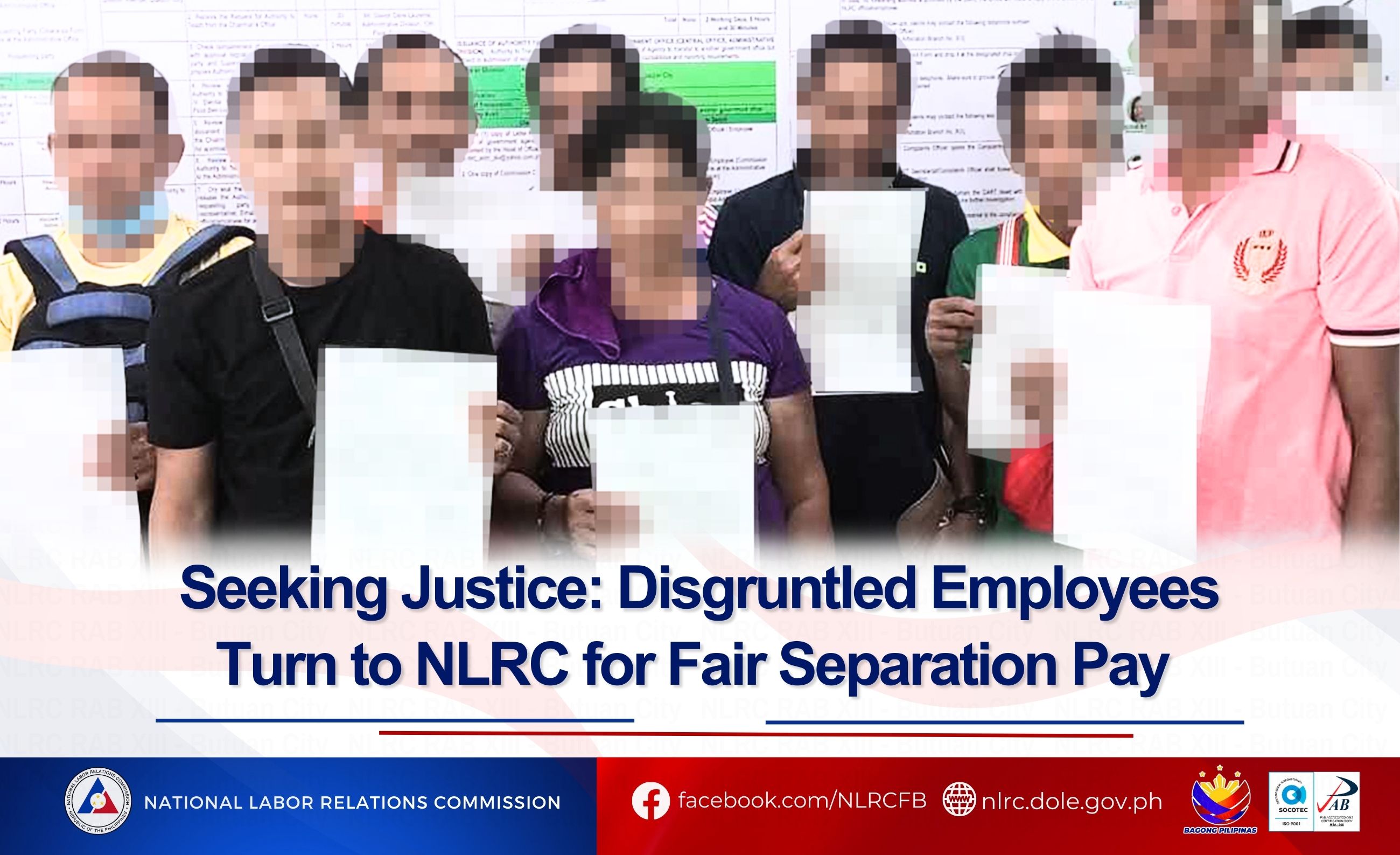
Seeking Justice: Disgruntled Employees Turn to NLRC for Fair Separation Pay
BUTUAN CITY – The closure of a company often comes with a host of challenges, with employee dissatisfaction over separation pay being a significant concern. In the wake of such circumstances, the National Labor Relations Commission (NLRC) emerges as a crucial avenue for these employees to seek equitable treatment and to uphold their rights. Among numerous complainants, several have opted to turn to the NLRC after unsuccessful attempts at conciliation-mediation through the Single Entry Approach (SEnA), all with the aim of securing their rightful separation pay.
In the face of company closures, employees often find themselves navigating the complex and emotionally charged realm of separation pay negotiations. The NLRC serves as a beacon of hope for workers who believe they have been unjustly treated in the workplace.
As the agency mandated to safeguard the interests of both workers and employers, the NLRC plays a pivotal role in ensuring that employees receive fair and just compensation, even amid the occurrence of company closures.
The NLRC’s involvement becomes particularly crucial when conciliation-mediation efforts, such as those undertaken through SEnA, prove unsuccessful in resolving disputes amicably. For employees grappling with inadequate separation pay, the NLRC offers a platform by which to seek legal redress and ensure that their rights are upheld.
While a multitude of complainants have sought assistance from the NLRC, their experiences reflect a broader pattern of employees across various industries who have chosen to assert their rights. These individuals believe that their contributions to the company warrant fair and reasonable separation pay. By resorting to the NLRC, they place their trust in a legal process that can address their concerns and provide an avenue for fair resolution.
In a time when job security is paramount and financial stability is essential for the affected employees and their families, the NLRC stands as a balancer of interest between the workers’ rights and the management prerogative of the employer. END
