
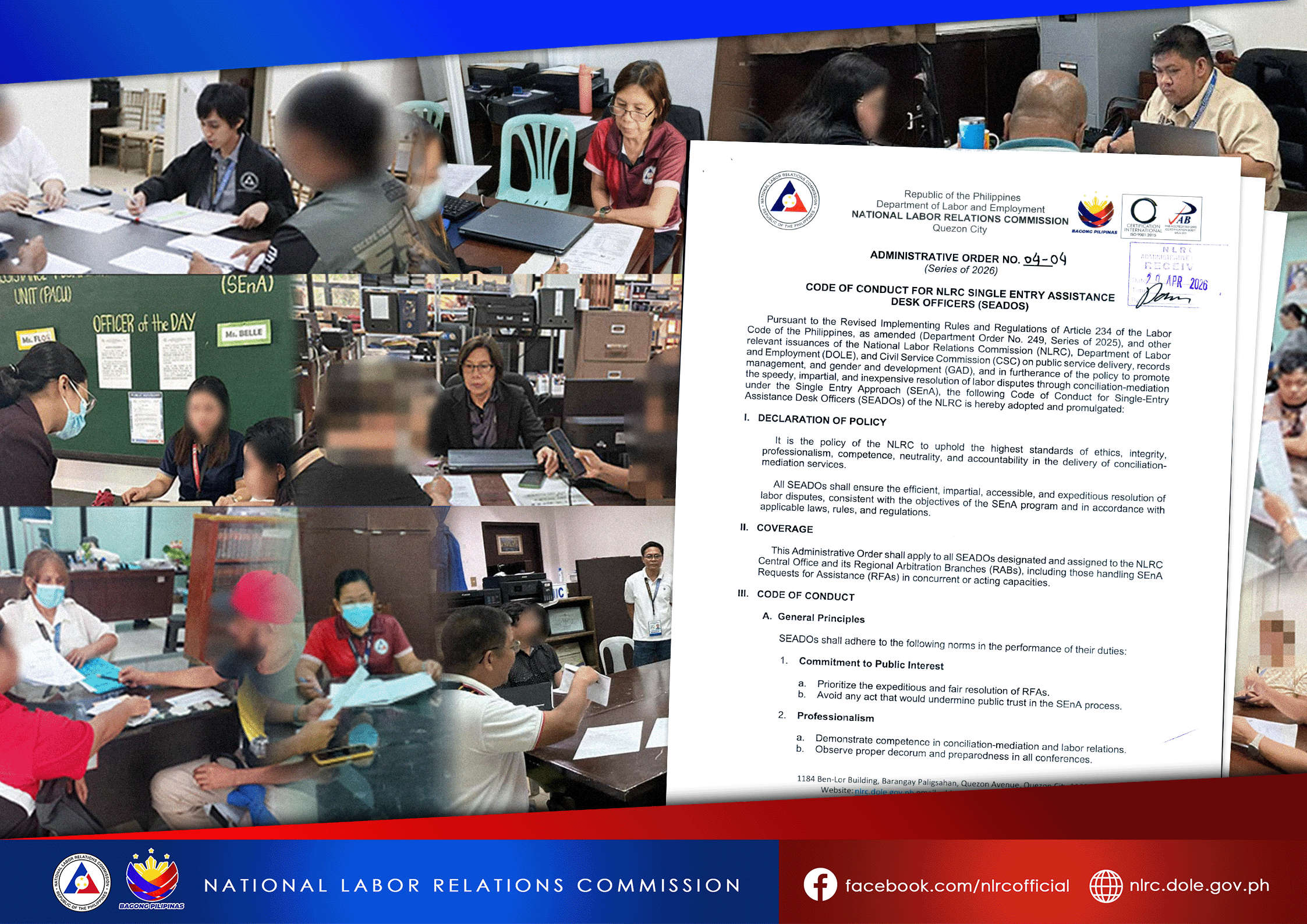
NLRC Adopts First-Ever Code of Conduct for SEnA Desk Officers
Quezon City – The National Labor Relations Commission (NLRC) has formally adopted its first-ever Code of Conduct for Single Entry Assistance Desk Officers (SEADOs) through Administrative Order No. 04-04 (Series of 2026), issued by Chairperson Grace E. Maniquiz-Tan. This initiative reinforces the Commission’s commitment to promoting ethical, efficient, and accessible dispute resolution under the Single Entry Approach (SEnA).
Aligned with the Revised Implementing Rules and Regulations of Article 234 of the Labor Code, particularly Department Order No. 249, Series of 2025, the Code incorporates relevant standards from the Department of Labor and Employment (DOLE) and the Civil Service Commission (CSC). It is designed to ensure that conciliation-mediation services are delivered with integrity, professionalism, and accountability.
Notably, the NLRC handles approximately 35% to 40% of the total Requests for Assistance (RFAs) processed nationwide under the SEnA Program of the DOLE, underscoring the critical role of its SEADOs in frontline dispute resolution.
Reaffirming the NLRC’s policy, the Administrative Order emphasizes the need to uphold the highest standards of ethics, neutrality, and competence in handling RFAs. SEADOs are thus directed to facilitate the speedy, impartial, and cost-efficient resolution of labor disputes in line with the objectives of the SEnA program.
Clear standards of conduct are established, focusing on public service, neutrality, and responsiveness. Responsibilities of SEADOs include case assessment, facilitation of conciliation proceedings, assistance in settlement negotiations, and monitoring compliance with agreements. To promote transparency and accountability, all proceedings must be accurately documented in the DOLE-ARMS system, while strictly observing confidentiality and the principles of voluntariness and informed consent.
Prohibited acts are likewise defined to safeguard the integrity of the process, including giving legal advice, accepting undue benefits, or disclosing confidential information. Compliance with conflict-of-interest rules, proper records management, data security protocols, and applicable ICT policies is also required.
Overall, the adoption of this Code represents a significant step toward strengthening the integrity and effectiveness of conciliation-mediation processes within the NLRC, ensuring that stakeholders are provided with a fair, transparent, and efficient mechanism for resolving labor disputes.
#NLRC #SEnA #CodeOfConduct