
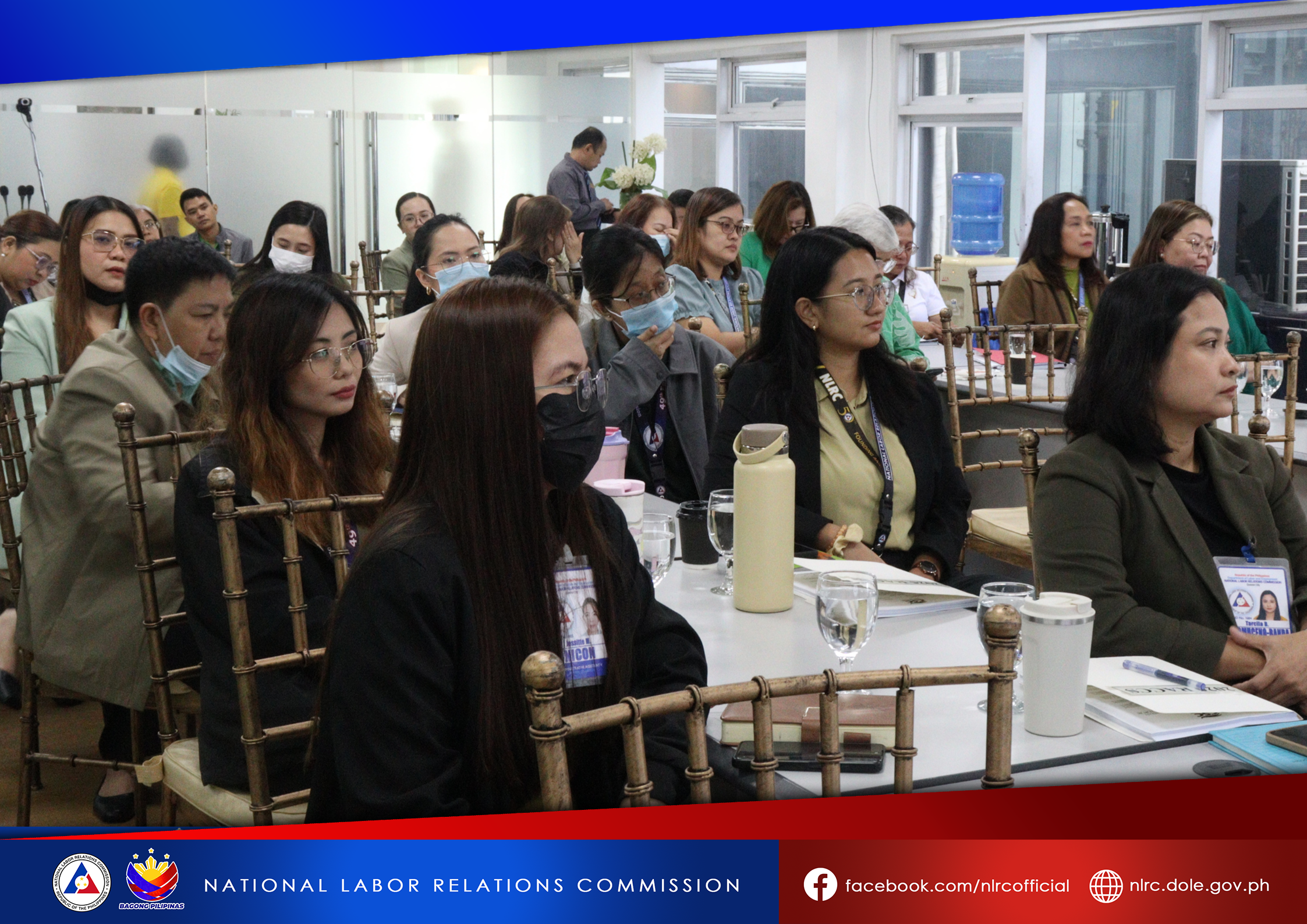
NLRC Holds Orientation on 2025 Rules on Administrative Cases in the Civil Service
Quezon City — In its continuing efforts to standardize and strengthen procedures in handling administrative complaints, the National Labor Relations Commission (NLRC) conducted an orientation on the 2025 Rules on Administrative Cases in the Civil Service (RACCS) on August 28, 2025, held at the NLRC Main Office and via Zoom.
The orientation was attended by 50 participants, composed of members of the Administrative Complaints Committee (ACC) from Luzon, Visayas, and Mindanao, along with representatives from the Administrative Division and the Legal and Enforcement Division.
As part of her policy direction, NLRC Chairperson Grace E. Maniquiz-Tan stressed that the effective implementation of the RACCS is key to strengthening accountability and integrity in public service, as the Commission commits to align its internal processes with civil service standards for fair, transparent, and efficient case resolution.
“This orientation is timely because the 2025 RACCS became effective on August 4, 2025. And, with the recently enacted laws and jurisprudence, we really have to update our procedures. This is towards conducting fair, speedy, and judicious handling and disposition of administrative cases,” said Director Elvira F. Cruz of the NLRC’s Management and Administrative Department.
OIC Chief Katherine Mae B. Perez of the Administration Division provided an overview of the 2025 RACCS, updated by the Civil Service Commission (CSC). She noted that the new Rules now consist of 159 sections across 23 rules, integrating provisions from Republic Act No. 11032 or the Ease of Doing Business Act, and Republic Act No. 9285 or the Alternative Dispute Resolution Act, and landmark Supreme Court decisions, including BIR v. Gan-Lim, Gatchalian v. Urrutia, and Flores-Concepcion v. Judge Castañeda.
She also highlighted procedural and administrative innovations, such as: establishment of the Internal Affairs Board; revised rules on administrative defense of dishonesty; updated disciplinary rules on sexual harassment cases; conduct of virtual hearings before the CSC and its Regional Offices; guidelines for clarificatory hearings in appealed non-disciplinary cases; delegation of authority to the Assistant Commissioner for Legal; draft revised rules on preventive suspension; and draft policy on electronic filing and online service of interlocutory orders.
Former Labor Arbiter Leah T. Fortuna of the Office of the Chairperson explained the major changes between the 2017 and the 2025 RACCS. These include clarifications on jurisdiction, who may file complaints, additional requisites, and procedures on preliminary and formal investigations, as well as updated rules on offenses and decisions.
“Section 158 indicates that the Rules shall govern all cases filed after they take effect, which means that from August 4 onwards, all complaints filed against our employees will now be governed by the 2025 RACCS,” Arbiter Fortuna emphasized. ”The Rules are also applied to all further proceedings in cases then pending, except to the extent that their application would not be feasible, would work injustice, or would violate substantive rights, in which event, the previously applicable rules shall apply,” Arbiter Fortuna added.
Meanwhile, NCR Executive Labor Arbiter Paz Eugenia Neri-Dysangco discussed the powers and functions of the Administrative Complaints Committee (ACC), which is authorized to conduct fact-finding and preliminary investigations. Its functions include receiving and evaluating complaints; issuing summons and subpoenas; accepting evidence and pleadings; conducting preliminary investigations and submitting a report with recommendations; taking custody of records; and exercising other powers authorized by the disciplining authority.
Following the orientation, a consultation meeting on ACC procedures was held to discuss and agree on internal guidelines. The discussions covered several key points, including the term duration for ACC members and the secretariat, proper signatories for issued orders, clearances and certifications, applicable fees, and mailing responsibilities. These guidelines are intended to align with DOLE Administrative Order No. 22, Series of 2020 and the CSC’s 2025 RACCS.
In her closing remarks, Director Maria Ricasion B. Tugadi of the Research and Legal Department expressed her gratitude to all participants of the ACC's first training. She envisioned future meetings to further strengthen the institutionalization of the ACC's rules and guidelines. Lastly, she encouraged participants to embody true civil service by committing to better public service delivery.
#NLRCRACCS2025 #PublicServiceIntegrity #GoodGovernance