
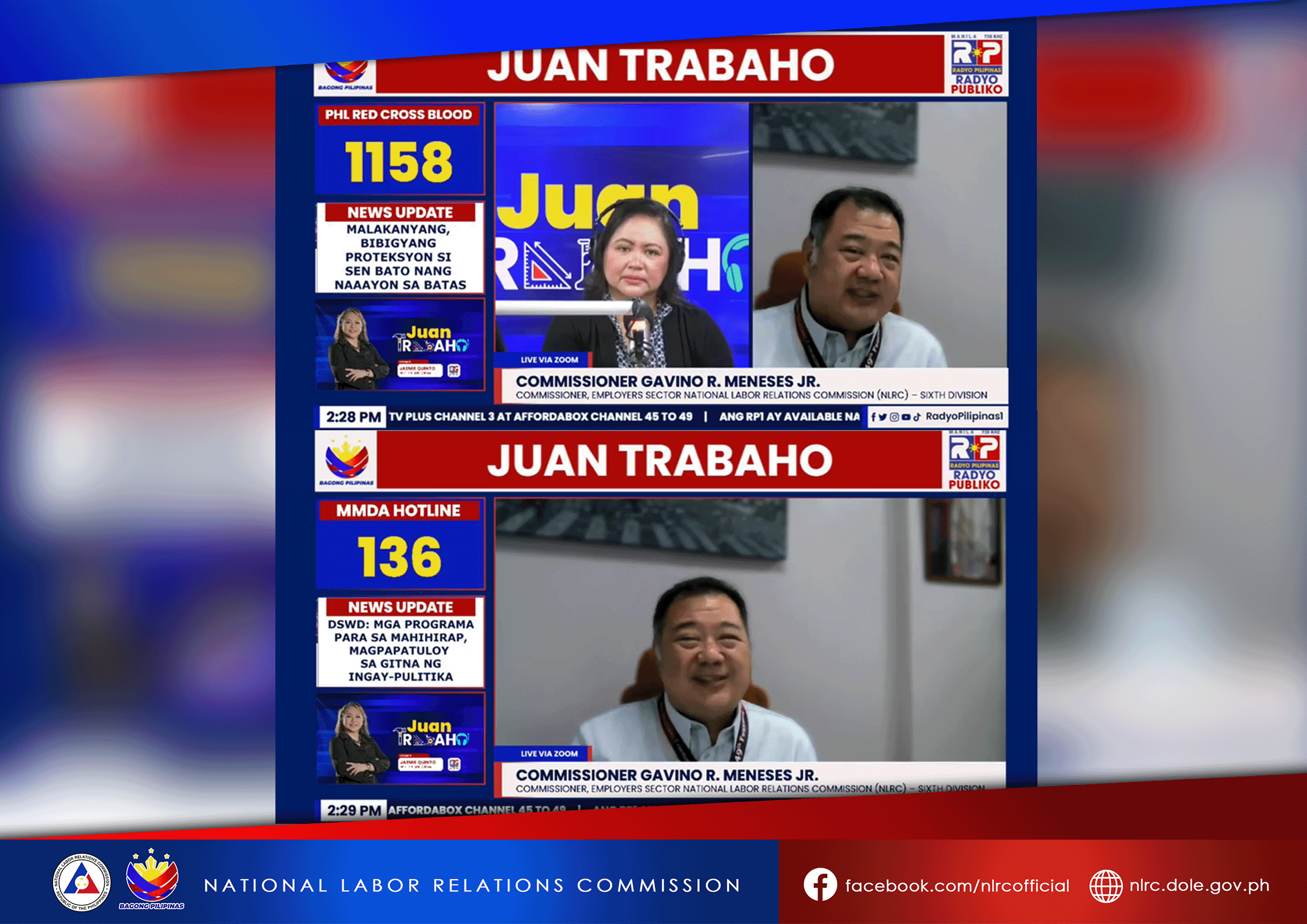
NLRC Commissioner Clarifies Rules on Employee Suspension on Radyo Pilipinas
QUEZON CITY—In a move to empower Filipino workers with a better understanding of their rights, the National Labor Relations Commission (NLRC) discussed the rules on employee suspension in an interview on Radyo Pilipinas on May 12, 2026.
During the broadcast of the program “Juan Trabaho” via 738 kHz with livestream on the Radyo Pilipinas Facebook page, Commissioner Gavino R. Meneses, Jr. of the NLRC Sixth Division spoke with program host Jaemie Quinto about the types and grounds for employee suspension. He emphasized that while employers have the right to impose such, they must strictly adhere to the due process outlined in the Labor Code.
Commissioner Meneses highlighted the critical distinction between the types of suspension often encountered in the workplace, namely, preventive suspension and disciplinary suspension. He said that an employer may place a worker under preventive suspension if “their continued presence poses a serious and imminent threat to the life or property of the employer or co-workers.” Meanwhile, punitive or disciplinary suspension is imposed after an employee is proven to have committed an offense.
“Under the Labor Code, preventive suspension must not exceed 30 days. If the 30-day period expires and the employer extends it, the worker must be paid their wages during the extension. Otherwise, this may ripen into constructive dismissal,” Commissioner Meneses explained.
Commissioner Meneses stressed that an employee must receive a notice of suspension that clearly indicates the 30-day duration. The employee must also be formally notified or instructed to report back after the suspension expires.
If workers think that they did not receive due process or have been illegally suspended or "constructively dismissed", Commissioner Meneses said that they may file a Request for Assistance (RFA) through the Single Entry Approach (SEnA) Program in the Department of Labor and Employment, or before any of its regional offices, bureaus or attached agencies. The SEnA program provides mandatory conciliation-mediation process to settle disputes amicably without reaching a full-blown legal case.
“If mediation fails, workers will receive a referral letter to be presented to the NLRC Complaint Unit where the process for Labor Arbitration will start,” he said.
Commissioner Meneses added that an employee may file SEnA RFAs online or on-site at the Regional Arbitration Branch where they may also avail of free legal services from the Public Attorney’s Office and the Integrated Bar of the Philippines.
For more information, the public may visit the official NLRC website at https://nlrc.dole.gov.ph/.
ᴘʀᴇᴘᴀʀᴇᴅ ʙʏ:
ᴇʀɪᴋᴀ ᴠ. ᴍᴀꜱɪʟᴀɴɢ
ɪɴꜰᴏʀᴍᴀᴛɪᴏɴ ᴏꜰꜰɪᴄᴇʀ ɪɪɪ, ʀɪᴘᴅ